Enter your email for a chance at
$1000
to use in the Special Learning Store!!
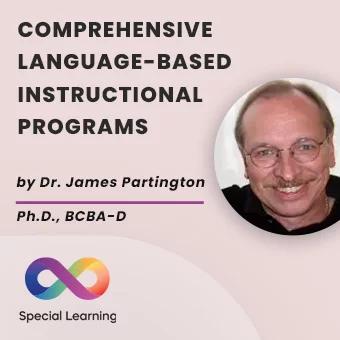
For educators and families choosing language-learning priorities, James Partington examines specific skill assessment, the different functions of communication, and teaching across daily routines in this recording, with examples involving meals, laundry, and playground visits.
Presenter biographies: James Partington.
MANDATORY DISCLAIMER: The Behavior Analyst Certification Board (“BACB”) does not sponsor, approve, or endorse Special Learning, the materials, information, or sessions identified herein.
Partington uses assessment grids and a common-object labeling example to show how broad descriptions can miss specific skill gaps. He distinguishes requesting, labeling, vocal imitation, and talking about absent things, even when the spoken word stays the same.
A spontaneous comment about a dog illustrates his concern that repeated follow-up questions can turn communication into work. Daily-routine examples connect parent participation with imitation, listening, requesting, and recounting experiences before, during, and after an activity.
The extended Q&A discusses classroom staffing, prerequisite skills, visual supports, transfer across instructors, reinforcement, and bilingual communication.
Recording context: The recording date is unavailable, and Partington states that the session cannot answer every individual child's programming questions.
The six-item evaluation mean was 4.74/5 across 11 complete responses, from 96 recorded rating responses. This mean includes only complete six-score responses. Source: Special Learning's course evaluation records, snapshot October 11, 2026.
Three selected anonymous responses appear below, with the wording and spelling retained. They describe learners' experiences and requests; they are not a guarantee of results or a claim that these comments represent every learner.
This was great - a good review for me.
Course evaluation response, 2023
The course was very helpful and easy. Thanks
Course evaluation response, 2023
Adding subtitles, many peoples have hearing problems
Course evaluation response, 2023