Enter your email for a chance at
$1000
to use in the Special Learning Store!!
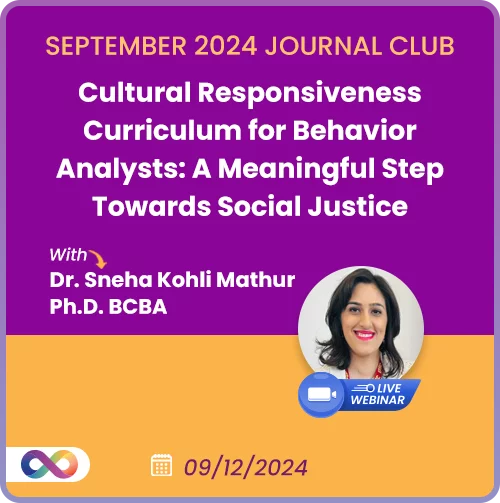
This recorded Journal Club features Sneha Kohli Mathur, with Maria Nicolaou hosting, examining cultural responsiveness in behavior analysis. The discussion connects critical race theory with a practitioner competency checklist and considers autism as a culture, neurodiversity, and autistic perspectives.
Presenter credits: Sneha Kohli Mathur.
For cancellations and refunds, please see our policy HERE.
In the presentation, Mathur distinguishes cultural competence, cultural responsiveness, and cultural humility. She introduces a checklist developed with her colleague Christine, linking cultural responsiveness domains to observable target behaviors drawn from critical race theory.
In a worked example, she discusses including clients in intake and treatment planning, attention to lived experience, and therapist–client power dynamics. The checklist also considers learning contexts, evidence of generalization, and whether practitioners need coaching, work independently, or can mentor others.
Mathur then explores autism as a culture through discussion of ableism, medical and social models of disability, neurodiversity, and the double empathy problem. Her closing summary considers autistic participation in research and graduate education, including guest speakers, autobiographies, accommodations, and meaningful paid consultation.
Recording context: Time did not permit a full discussion of the second article. The recording includes a summary of proposed actions.
Special Learning's course evaluation snapshot contains 0 rating responses for this recording. No rating average is shown, and no anonymous learner comment is reproduced here. Source: course evaluation records, October 11, 2026.
Para añadir una opinión sobre este producto es necesario adquirir el producto actual y estar autorizado.